This is an extract from my book in progress covering individual deities and broader topics and concepts regarding Celtic deities, rites and identity. It is a work in progress, and will no doubt be edited and expanded further down the line. Following on from my “Celtic Mother Goddess” article (with which there is some overlap, particularly with the hypothetical dawn goddess Albina), this takes the form more of a glossary. Whether or not the eventual book will retain this glossary format is to be seen.
The Male Sun
Belenos, Belinus (Gaul), Bel, Bile (Ireland), Beli (Wales)
Little is known about Belenos but given his status as a healing and solar deity and, as noted by Caesar, an equivalent of Apollo, he was no doubt a significant deity, recorded in various forms in Gaul, Ireland and Wales, with the ancient May Day fire festival that came to be known as Beltane being named after him making him the “May King”. The “Osirian” and “Dionysian” Green Man is slain on May Day (in the form of a man parading in the form of a crowned tree through the town before being torn apart) in British tradition, and strikingly similar traditions to this “Jack in the Green” exist in former Hallstatt or proto-Celtic territory such as Slovenia. With such local folk traditions passed down since the middle ages in Britain it becomes difficult to ascertain to what extent any are “purely Germanic” likely merging with previous Brythonic customs, and this tradition would indicate the existence of “twin” alter egos of Belenos and a Dionysus equivalent (possibly Cernunnos) and the rebirth of one coinciding with the death of the other as is the case in these festivities in the classical world (with Hera being linked to both the delayed births of Apollo and Artemis and the violent dismembering of Dionysus at the hands of the Titans). There are several Apollo equivalents mentioned by the Romans that could have originally been the same deity or act as epithets or Avatars of Belenos. Linguistically his name is linked to Baldr in Norse myth and Belebog in Slavic myth. Both Belenos and Baldr translate as “the shining one” or “the bright one”.
Belenos was associated with healing, like Apollo, and was closely associated with both horses and the wheel, suggesting a close link to other representations of a chariot-riding solar deity (such as Apollo) and to the bronze age image of the sun being drawn by the horse. This depiction of the sun being “carried” across the sky is symbolic, representing both the sun’s journey beneath the horizon and the waves and descent into the sea and the “Otherworld” and the unborn ancestor being carried in the womb. The horse is a significant pregnancy symbol. There is early iron age evidence in Austria (on a bucket lid) of a symbolic connection between solar symbols and horses rooted in this bronze age culture linking the two, as well as early iron age coins depicting the horse on the reverse with a solar symbol , with the solar wheel representing the rays of the sun, the daily rotation of the sun as well as linking to the symbol of the solar chariot that carries it below the horizon before it rises again the next day, and with summer. This solar chariot symbol, commonly but misleadingly associated with the spread of “Indo-European” culture (despite also being found in Mesopotamia) and the horse, should not be treated as wholly separate from the older Mediterranean solar barge tradition that is evident further afield and in Scandinavia, particularly in the stone ships found in Scandinavia, Germany and the Baltic dating from circa 1000 BCE onwards. The close association of Belenos with springs, such as at the Roman Baths in Bath, again emphasises this passage of the sun into the waters, with the solar barge relating to its journey beneath the waters as well as the notion of the sky as a “reflection” of the sea and vice versa. The horse is not strictly linked to the land however, as the association of Poseidon or Neptune with both the sea and horses shows, and as evident by the abundance of sea horses in Celtic folklore, with the role of the horse as a psychopomp being both earthly and aquatic in nature.
There would appear to be a degree of overlap between mythical figures linked to healing, rebirth and the rising sun – such as Belenos, Baldr, Apollo, Mithra in Iranian myth (who is also closely linked to oaths) and Amaterasu in Japanese myth – and the “dualistic” battle between light and dark forces, which will be discussed at length relating to these paired deities in Celtic myths, but appear to relate more in large part to dusk and the setting sun, or the descent of a deity into the underworld or Otherworld. Though distinctions are rightly made between the Apollo and Baldr parallel and the Hermes or Mercury and Óðinn parallel, there is in these early Celtic communities a widely worshipped celestial deity relating to the sky and the sun closely associated with the horse that appears to be connected to this battle between light and dark, and likely relates to this central solar deity recognised as Belenos. This native Gaulish sun and sky god rode down to battle the chthonic forces that were symbolised by a giant with a large head and snakes for lower limbs, which can be compared to an ancient symbol of a figure, sometimes crouching, often seen with snakes or grappling with snakes.


The image of a hero flanked by two beasts is a common and ancient motif, be it snakes, goats or lions, but this link between the crouching or seated figure and snakes is interesting, particularly that between two snakes and a visible threefold symbol, such as the triskele on the stone from Gotland, or with a three-faced chthonic deity. This may represent the three symbolic rebirths, as well as the past, present and future, with the solar symbol being closely linked to this cycle of rebirth, which could explain the link to such triskele solar symbols. The link between the sun and snakes, and therefore between rebirth and snakes, is important, with the possible link between the Gorgon at Bath and a solar deity being further suggested by this link in the aforementioned snake-legged giant. The cave has a close association with both rebirth and the sun (in Mithraic cults and in the Amaterasu myth, for instance) as well as with serpents, or dragons, with the often in a sense invincible or multi-headed serpent, such as the Hydra, representing both the eternal and reincarnating nature of this solar “gorgon” symbol” as well as the eternal thread of this dragon that the hero must face and conquer – and the fear and malevolence that he must conquer – in his rite of passage. This can also represent the “battle” commencing in the Otherworld or womb and this solar deity representing the rebirth of the ancestor and the light and sight that comes to the newborn at birth. Sometimes this “sky warrior” displayed more unambiguously solar symbols, carrying a thunderbolt as a weapon and a sunwheel as a shield in some depictions. This dualistic battle is also a feature of Slavic tradition between the white and black god – Dazbog and Czarnobog – and Egyptian tradition in Ra’s descent beneath the earth that the “eye that scorches millions” burns with its flame as it descends. Again in this tradition the battle between twins – Ra and his serpentine brother Apep – is found, resulting in the dismembering of the snake, and in several scenes in Egyptian iconography Ra takes the form of a cat in doing so.
Aside from the dualistic battle and cyclical rebirth association of the solar god, be it Belenos or the female solar equivalent, there are also the initiation aspects relating to the gorgon and the sun as the evil eye. As with Athena, Minerva and Medusa in Hellenic, Etruscan and Roman tradition, closely associated with the initiation of youths, the symbology of the gorgon – whether it relates to Belenos, Oceanus or perhaps both – is significant, particularly when related to the giant Balor Béimnech (“Balor the Smiter”), Balor Birugderc (“Balor of the Piercing Eye”) and Balór na Súile Nimhe (“Balor of the Evil Eye”) who is likely related linguistically and to some extent a later development of the scorching eye of the solar god in Christianised Irish oral tradition.
Belenos’ name is also most likely linked to Belinuntia), a name for Black Henbane that despite its toxicity was once used for its healing properties, and possibly to some degree in rituals for its psychoactive properties as well. This plant was also once used in brewing beer, in the homeland once home to the proto-Celtic Hallstatt culture at least, where the town Pilsen gets its name from the German name for the plant, Bilsenkraut, which may itself be related to the same root word. As noted, Belenos’ role in healing, ensuring fertility and rebirth and in bringing light carried over into the Beltane festival on May the first.
Grannos (Gaul, Britain)

There are many possible deities that could be listed as possible avatars and epithets of Belenos as already noted, but one of note is Grannos, worshipped as a god of thermal springs on both Britain and the continent. His name “Grannos” was long linked to the root word for “burning” or “shining”, “greinā”, from which stems the Irish word for sun “grian”. This has, however, been debated since, with his name being linked to the word for the Proto-Celtic root for beard – “granno” – and the Proto-Celtic word for heat – “grenso”.
Though the exact nature of Grannus is up for debate, the Romans did equate him with Apollo and assimilate him with Apollo at Gallo-Roman places of worship. One such place is the German city of Aachen, called “Aquis Granni” (at the waters of Grannus), which suggests there was a sanctuary to Grannus, likely a sacred spring or well from the Romano-Celtic period, much like that of Sulis at Bath, which would further indicate he was indeed a solar healing deity.
In Auvergne, customs continued into the twentieth-century that involved singing chants around bonfires. A sheaf of corn was set on fire, and named “Granny mio”, while the people sang “Granno, my friend; Granno my father, Granno my mother” – here the surviving ancestor worship is clear, and one might also connect this to the role of the placenta both in linking the newborn and reincarnated ancestor to the parents and as a “friend”, companion or twin of the fetus in the womb.
Grannus’ female consort was Sirona, or Ðirona, who is mentioned together with him in many inscriptions. In some of these Grannus is simply mentioned with Apollo, so the name appears to have been used synonymously with both figures. The name Sirona is undoubtedly Celtic in origin meaning ‘star-goddess’, and linked to Welsh “seren” – “star”. The pairing of the two would further suggest Grannos being worshipped as a solar or stellar deity.
Sirona is often depicted carrying grapes and grain, which may symbolise either the coming of the harvest with summer, the nourishing of the fetus in the womb, or, in all likelihood, both. This we may also liken to the importance of fruits in other European pantheons, with the grape vine being a variant of the world tree symbol in Iranian art, and Iðunn’s apples in Norse mythology, which are comparable to several variants on the Otherworld in Celtic mythology, with this presence of grapes, grain and cornucopias with some harvest- and fertility-related gods and goddesses likely relating to this process of nourishment and rebirth, especially when closely linked to a solar deity. Sirona has been classed as originally being an Earth goddess, as indicated by interpretation of her name as meaning “the long-lived” (1-book-find), which, again, we can link to fruits such as Iðunn’s apples and the coming of the sun and the fountain of youth in the myth of Cailleach Bhéara, whose myth itself shows how closely linked healing springs and the sun were as regenerative, youth-giving and resurrecting powers.
Borvo, Bormo or Bormanus: Another god of springs, and origin of Welsh “berw” or “boiling”.
Maponos: Linked to words denoting “youthfulness”, much like Apollo, so to healing, the sun and rebirth
Mogons, Mogounos: Derived from “Mago” – “to increase” – and related to youthful strength, another possible sun god, though some evidence points to him being a broader sky god.
The Female Sun
Sulis, Sul (Britain), Sulevia or Suleviae (Britain, Gaul)

One might speculate about the “gender” of the early Celtic solar deity, and over whether there was a central male or female solar deity or both a male and female deity widely worshipped and personified. Both reversal of masculine and feminine aspects and the presence of an equivalent consort are common features in any pantheon, so given the presence of both at the temple in Bath it is likely that Belenos and Sulis (and by extension Brigid and Brigantia) are a duo of solar fertility consorts and siblings, much like Freyr and Freyja in Germanic tradition and Apollo and Artemis in Hellenic tradition. There is, however, argument for the sun being “originally feminine” as a mother of creation, and the moon being “originally masculine” (due to its link to divination, the waters and women’s cycles and to controlling them. This is the case with the ancient Anatolian mother goddess, Arinna and the feminine eye of Ra (the sun, and perhaps the original form of the “Aten”) , and closer to home in Norse tradition the male moon and female sun continued to be preserved as Mani and Sól. Her name likely linked to the Proto-Celtic word for sun, “sūli”, and Proto-Indo-European “suhlio”. A notable example of a female solar deity is that of Sulis, or Sul, equated by the Romans with Minerva (as was Brigante or Brigid, who may be related or equivalent to Sulis) at Bath and Hesse, where eternal fires burned in fire temples. Sulis’ presence as the syncretic “Sulis-Minerva” at Bath further ephasises this connection. Brigid was similar in this respect, and in these temples priestesses equivalent to vestal virgins served the goddess, linking Sulis and Brigid to the perpetual virgin of the classical world and in particular Hestia and Vesta.
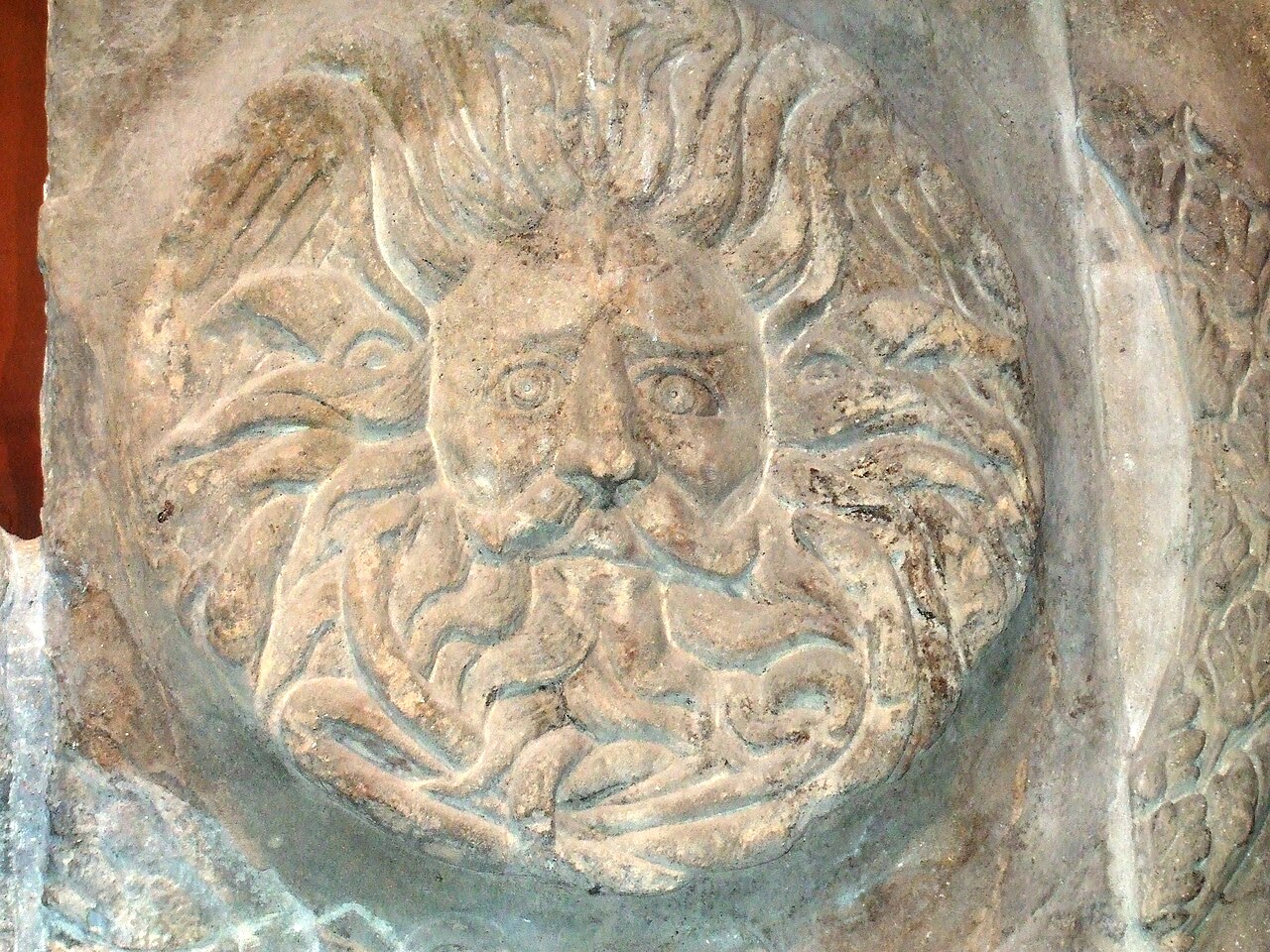
As indicated by Sulis’ worship at bath, like other Apollo equivalents she was closely associated with healing and reviving springs. Even the gorgon adorning the temple at Bath appears to be native in origin and style. The bearded appearance may even tie this god to the old skyfather, as Dionysus or “young Zeus” was tied to his father as “God the Son” (himself occasionally depicted in an aged, sickly form). Both bearded and infantile renderings of the Gorgon’s face are found in Hellenic and Roman tradition.
Sulis also appears to be linked to the goddess Sulevia, with them likely being the same deity originally. Sulevia was often worshipped in the plural form Suliviae, comparable to the Matres, indicating the goddess’ status as a guardian and a mother as well as filling an alternate role similar to that of the fates in Greco-Roman myth, or the Norns in Norse myth, and as is often the case with the “virgin goddesses”, paradoxically embodying both virginal and motherly qualities and functions, in certain contexts taking the form of maiden, mother and crone, which is particularly apparent when deciphering almost unfathomably complex “creator-destroyer” deities. One reason for this is deities simultaneously representing different stages of development and rebirth, another is the way in which impossible paradoxes were used throughout European mythology to draw attention to riddles. The number three has long had huge significance in both Christian and pre-Christian theology, relating to a central de facto trinity of the virgin mother, God the Father and God the Son and is widely found throughout Celtic culture in triquetra and triskele symbols, and the three-legged “swastika” such as that found on the flag of the Isle of Man (as well as that of Sicily). Sulis or Sulevia as a triple goddess emphasises her closeness to Brigid or Brigantia, with them likely being alternate epithets or regional variations of the same deity.
Brigantia (Gaul), Brigid (Ireland), Bride (Scotland)

Perhaps the best-documented and significant solar deity – male or female – in all of Celtic tradition and folk customs is Brigid or (in the iron age) Brigantia, undoubtedly a goddess of huge significance that took a central role in Celtic worship. A complex and multi-layered deity as much as Athena and Minerva to whom she is rightly compared, she is known as “the smith” in Celtic tradition as well as the “civilising” deity of their culture, as Athena and Minerva are in Mediterranean tradition. Functioning as a dawn goddess also (as Athena, the owl, effectively was as a deity “between worlds” and between night and day), one must note the presence of deities in traditions perhaps most notably in Egyptian theology that each relate to a specific position of the sun, with Ra taking form as a dawn, midday and dusk deity, each with a different name and form. She was linked to fire, fertility and inspired artists, poets and craftsmen, and J. A. MacCulloch argues that she “must have originated in the period when the Celts worshipped goddesses rather than gods”. Though the shift towards patriarchy in line with changes in social structure is easy to exaggerate and misunderstand, such as in relation to the role of Apollo at Delphi, it is clear that Brigid and Brigantia lay at the heart of a notably matrilineal tradition in Celtic culture. This role as with Athena and Minerva in initiating warriors as well as the link to smithing and armour is also comparable to Amazons in Greco-Roman tradition (likely relating to Scythians with a degree of historical basis), and to the Valkyries and shieldmaidens in Germanic tradition and the prominent role women played in martial affairs and in peacekeeping.

Brigid is the daughter of the Dagda in Irish tradition the Gaelic equivalent to Woden in Germanic tradition with some Dionysian elements and both Zeus or Jupiter and Hades or Pluto in Hellenic and Roman tradition. It is also notable with regards to the Woden parallel that his consort is the battle crow, the Morrigan, a triple goddess and comparable to Woden’s ravens Huginn and Muninn (“memory” and “mind”). Likewise closely associated with wisdom and divine inspiration, as was Athena as the “feminine Helios” in Hellenic tradition, she is likewise tied to the skyfather and his chthonic alter ego, a division apparently less apparent and pronounced in Germanic and Celtic pantheons than in Hellenic and Roman ones. A Gaulish find depicts her in armour with a raised helmet shielding her from the sun like Athena’s, and a swan crest decorating her helmet. Another Romano-British syncretic depiction shows her holding the spear with the Aegis on her chest like Athena and Minerva.
One should keep in mind how relatively late these narratives relating to Brigid are, and the diminishing of the Tuatha Dé Danann in Irish tradition. In the Cath Maige Tuired of the Mythological Cycle, Brig is the wife of Bres, an ambivalent figure who had the Tuatha Dé serve the Formorians as slaves, and whose name means “red” or “rust”, which could link him to an original Thor parallel or storm god, given the the tendency of them (Thor especially) to be associated with red hair. This would in turn link Brigid to the storm god, like the fiery mother in Slavic tradition (Ognyena Maria) stemming from the wife of the storm god (Perperuna). Given her close parallel to perpetual virgin deities, however, such a place in mythology specific to Brigid rather than other less well-documented Celtic mother goddess figures is perhaps debatable, and it may be that aspects of another deity were assimilated into later folklore around Brigid because of the prominence her cult and festival had. Though a perpetual virgin in theology, and indeed virginal in her origin in the head of the skyfather, Athena serves a maternal function in initiating youths as well as, along with Medusa, having a link to rebirth in childbirth. Likewise regardless of whether or not Brigantia had a consort or was herself a virgin goddess much like Athena and Artemis (which would make sense), her role was similarly maternal, in terms of both initiating youths and as a mother to the tribe.

J. A. MacCulloch wrote that on “St Bride’s Day” (Imbolc, February 1st, as in Irish tradition) in the Hebrides, Scotland there was a custom of placing an oat dolly dressed in women’s clothes and a club in a basket before saying “Briid is come, Briid is welcome”. Coinciding with the coming with spring this emphasises Bride’s connection to the harvest and to grain, comparable to Demeter and Persephone and their coming and going with the seasons (as well as knotwork seen across Europe as well as hair braids resembling the sheaf of grain). The club, possibly linked to the grinding of grain, may also suggest another Athena or Minerva parallel, given the latter’s close connection to the club-wielding Herakles (a figure present in much of Celtic tradition in their own equivalents) and role in initiating youths and warriors. One may also note the strong Pictish connection to this figure and initiatory role of youths, considering the part of the Táin that sees the rather Herculean Cú Chulainn trained by a Pictish woman when he sails across from Ulster. Anthony Adolph argues that the name Brigid comes from the word Britain; there is most likely a close link between Brigid and Britannia (and the personified goddess Britannia, like the goddess Roma) but whether the country is named after the goddess or the goddess is named after the nation or tribe, as with Athena, remains a mystery. Regardless, this further demonstration of her role at the centre of a matrilineal culture and religion is the fact that she was viewed and a name as a mother of the tribe, contrary, perhaps, to common assumptions that barbarian cultures only named a tribal “allfather” and not a tribal “allmother”. She remained of huge significance to the Picts, and until the 800s CE queens continued to be seen as incarnations of her, with king consorts preserving honourific titles such as Bruide, Bredei and Bred, highlighting her role not only in founding the civilisation and culture of the Celts, but also in matrilineal customs of giving the king his power.

Bibliography:
Adolph, Anthony, Brutus of Troy: And the Quest for the Ancestry of the British, Barnsley, Pen & Sword Books Limited, 2015
Davies, Sioned (translation), the Mabinogion, Oxford, Oxford University Press, 2008
de Grummond, Nancy ; Simon, Erika, The Religion of the Etruscans, Austin, University of Texas Press, 2006
Kinsella, Thomas (translation), The Táin, Oxford, Oxford University Press, 1969
MacCulloch, J. A., The Religion of the Ancient Celts, Edinburgh, T. & T. Clark; London, Constable and Company, 1911; 1991